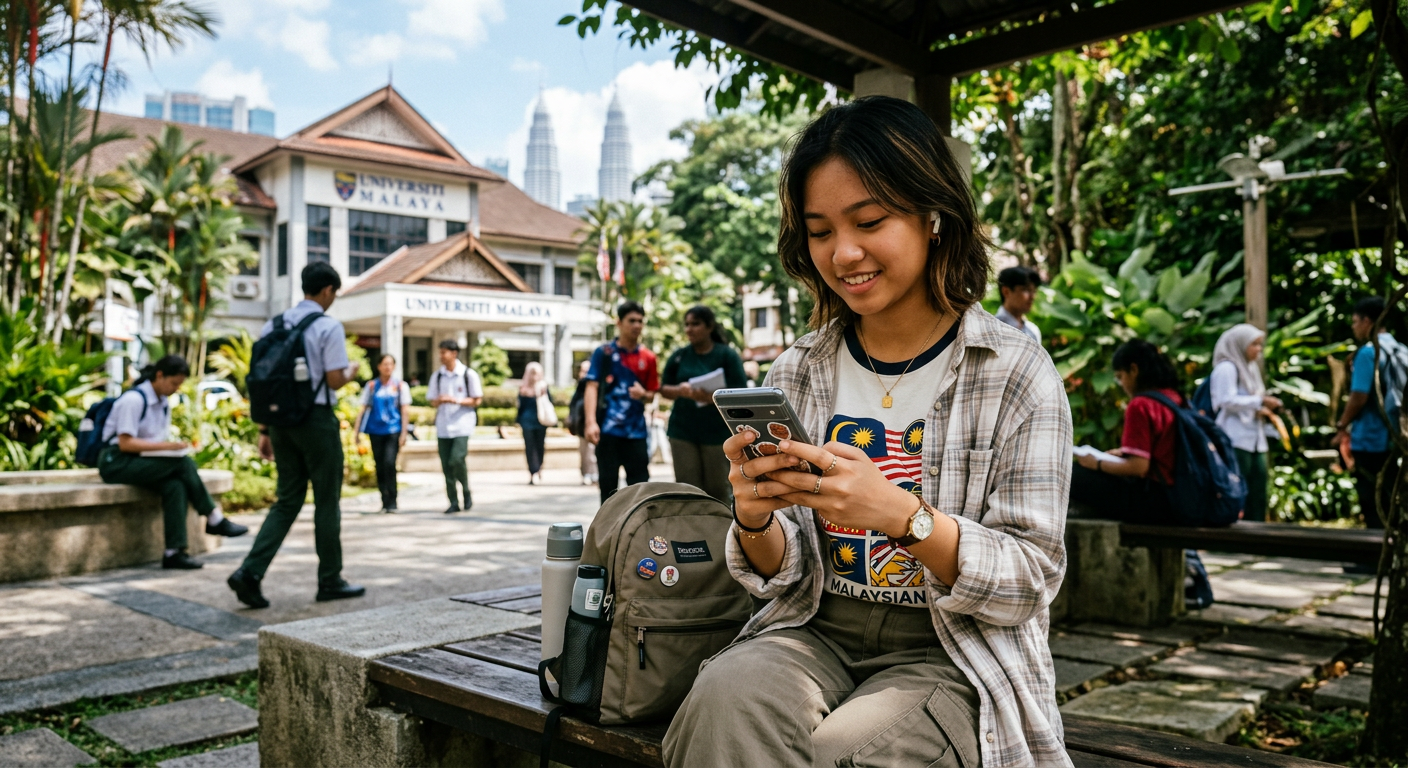
Who they are
Gen Z makes up 31% of all Malaysian online consumers — the second-largest generational cohort after Millennials. But they are not a KL-centric generation. The data shows they are more likely to live in small towns and rural communities than the average Malaysian consumer. If you’re targeting them, your geo-settings may need to go wider than Penang and the Klang Valley.
They skew male at 55%, and a significant share — 46% — come from low-income households. That is a notably higher proportion than the average consumer. This shapes purchasing behaviour: they are price-conscious in ways that show up not as discount-seeking but as selectivity. They have fewer dependents and many still live in larger family households, which changes the unit economics of what they spend on versus what the household spends on.
Most are early in their working lives or still in education. This shows in what they care about. When asked what matters most to them, career advancement and success top the list — at 55% and 51% respectively. A happy relationship comes third at 50%. Cost of living and inflation sit much lower on their list of national priorities — only 28% flag it, compared to 46% for all consumers. They are not unconcerned with money, but their relationship with it is different from consumers who are managing mortgages, children, or retirement planning.
Educationally, 44% have a bachelor’s degree or equivalent, which is roughly in line with the average. 23% have upper secondary qualifications and are eligible for university study. A small share — 8% — have pursued technical or vocational education.
On trust, 67% say they do not trust mainstream media. This matters more than it sounds. Gen Z does not rely on brand websites, news features, or editorial content the way older consumers do. They trust people, not publications.
What they care about
Entertainment is the dominant interest. 59% of Gen Z consumers are interested in movies, TV shows, and music — the single highest interest score across all categories measured. This is not a lifestyle statement; it is a behavioural fact about where they spend their attention. If your brand is not adjacent to this world — through content, through creators, through the things they watch — you are working in the dark.
Gaming is a significantly more popular hobby among Gen Z than among the average Malaysian online consumer. This is consistent with the pattern: they are interactive, screen-first, and drawn to worlds that feel participatory rather than passive.
Health and fitness (35%) and fashion and beauty (37%) round out the top interests. Career and education interest them more than average — 37% versus a lower baseline for older cohorts, which aligns with their life stage.
Travel and food and dining are each cited by around a third of this group, which tracks with their age range: they are travelling, they are eating out, they are building preferences.
What is notably absent from their expressed interests: religion and spirituality scores lower for Gen Z than for older cohorts. This does not mean they are irreligious, but it is not a primary stated identity in the same way it is for older Malaysian consumers.
On national priorities, unemployment tops their list at 59%. Government debt and the economic situation follow at 46% and 44%. Rising prices and inflation — the concerns that dominate older consumers’ responses — rank low for this group at 28%. This is the cohort that grew up with inflation as background noise; it is not new to them, even if the recent acceleration is.
Where to reach them
The channels that actually work
New in 2025: TikTok Shop has become the dominant social commerce channel for Malaysian Gen Z. TikTok Shop Malaysia reached 10.5 million active buyers in 2026, with 71% of them falling within the Gen Z cohort. More significantly, 67% of Gen Z social commerce purchases in Malaysia were made through creator video links — not brand advertisements, not search results, but creator-driven purchase paths. If you are not working with creators who can link to a shoppable video, you are not in the Gen Z purchase funnel for social commerce categories.
Live commerce is accelerating: Gen Z accounts for 44% of all live commerce viewers in Malaysia. This is not a niche behaviour — it is becoming mainstream entertainment-commerce. Brands that can integrate product into a creator’s live stream, or run their own live commerce events on TikTok, are capturing this audience in a moment of high engagement and reduced price sensitivity.
Gen Z does not search for brands. They discover them.
The data on digital advertising touchpoints is revealing. When asked where they encountered digital ads in the past four weeks, websites and apps of brands came top at 60%. Social media as a broad category reached 54%. Video streaming services — YouTube, TikTok pre-roll, streaming platforms — hit 62%, the highest of any single channel. Online stores (49%) and video game environments (21%) are also in the mix.
Search engines, which most brands treat as a primary digital channel, came in at just 38%. Fewer Gen Z consumers remember seeing ads on search engines than remember seeing ads on any other digital channel measured. This is not a flaw in the data; it reflects a behavioural reality. Gen Z does not go to Google to find products. They go to YouTube, they go to TikTok, they go to social platforms, and they go through people they follow.
This has direct implications for how you allocate digital budget. If you are moving money from search into short-form video placements and creator partnerships, the data supports that reallocation for this segment specifically.
On social media behaviour, the most striking finding is the gap between passive and active use. 55% of Gen Z consumers are passive social media users — they read, they watch, they consume. Only 37% have liked or commented on posts in the past four weeks. Posting pictures or videos? 22%. Following companies or brands? 13%, compared to 21% for all consumers. They are in the audience, not in the comments.
This matters for how you think about social media ROI. If your metric is engagement — comments, shares, follows — you are measuring the wrong thing for this group. Reach and view-through matter more. They are watching. They are just not responding.
The channels that underperform
Printed daily newspapers are the clearest dead zone. Only 17% of Gen Z consumers remember seeing ads in printed daily newspapers, compared to 28% for all consumers. Magazine print performs slightly better at 24%, but both are well below other channels. If print is part of your media plan for this segment, the budget belongs elsewhere.
Online news websites are also weak for this group. Only 10% regularly read online news, versus 24% for all consumers. If your content strategy involves publishing thought leadership on news sites and expecting Gen Z to find it, that assumption does not survive contact with the data.
Radio and outdoor advertising perform similarly for Gen Z as for the average consumer at around 43-49%, so these are not segment-specific vetoes — but they are not strengths either.
Device reality
96% access the internet via smartphone. This is effectively universal. Tablet and laptop follow at 67% and 69%. Smart TV at 42% is notably below the 47% average — Gen Z is more likely to watch video on their phone than on a connected TV, which has implications for video ad format and placement.
What to do
Make TikTok Shop and live commerce the centre of your Gen Z strategy, not an afterthought. TikTok Shop Malaysia had 10.5 million active buyers in 2026, with 71% Gen Z. Crucially, 67% of Gen Z social commerce purchases came through creator video links — not brand ads, not search. The purchase path for this segment runs through a creator’s video, not a brand’s ad. Set up your TikTok Shop, identify creators with shoppable video capabilities in your category, and make the creator video the conversion point — not a branded post that links out.
Build a short-form video presence, not a search presence. The data is unambiguous: search engines are the weakest performing digital channel for Gen Z, and video streaming services are the strongest. If you have not posted a video under 90 seconds in the past month, that is a gap. It does not need to be polished — the production quality of creator content often outperforms brand-produced content with this group. The bar is authenticity, not cinematography.
Stop measuring social media ROI by engagement rates for this segment. 55% are passive users. They read, they watch, they do not comment or share. If your social dashboard shows low engagement from Gen Z followers, it does not mean they are not there. It means they are watching. Track view counts and website referral traffic from social instead.
Gaming is an underserved channel for most brands targeting this segment. Video gaming is a significantly more popular hobby for Gen Z than for the average Malaysian consumer. If your brand has a plausible connection to gaming — even a loose one — in-game advertising, gaming-adjacent YouTube content, and creator partnerships with gamers will reach this group in an environment where they are genuinely engaged, not just passing through.
Do not lead with price or value messaging. Gen Z is less worried about inflation and cost of living than older cohorts. Discount-led messaging does not land with this group the way it does with Millennials or Gen X. Lead with identity, experience, and quality. The purchase decision is different when you are spending your own money on something you want versus something you need.
Local language and local cultural resonance outperform global campaign adaptations. This is consistent across the dataset — Gen Z in smaller towns and rural areas are more comfortable in Malay or local dialects than in English. Content that feels local, that uses references they recognise, that does not feel like it was briefed in from a regional office, will outperform a translated global campaign every time.
What not to do
Do not assume KL and Penang represent this segment. Small towns and rural communities are more heavily represented among Gen Z than among older generations. Your geo-targeting should reflect that.
Do not use celebrity endorsements over micro-creators. The 28% purchase-influence figure applies to influencers generally — not necessarily mega-celebrities. For most categories, a creator with 30,000 genuine followers in your target demographic will drive more attributable sales than a celebrity post.
Do not publish on online news websites expecting Gen Z to find you there. Only 10% regularly read online news. This is not where they encounter brands.
Do not treat TikTok as a billboard — it is a commerce channel now. The passive usage pattern means Gen Z is watching, but they are also buying. 67% of Gen Z social commerce purchases flow through creator video links, and 41% of live commerce viewers are Gen Z. The conversion mechanism is a creator’s shoppable video — if your TikTok content is not linked to a product and does not have purchase intent baked in, you are wasting a commerce opportunity, not just a marketing impression.
Do not skip mobile in your product or website strategy. 96% use a smartphone as their primary internet device. If your website does not load fast and function cleanly on mobile, you are not in the game with this segment.